
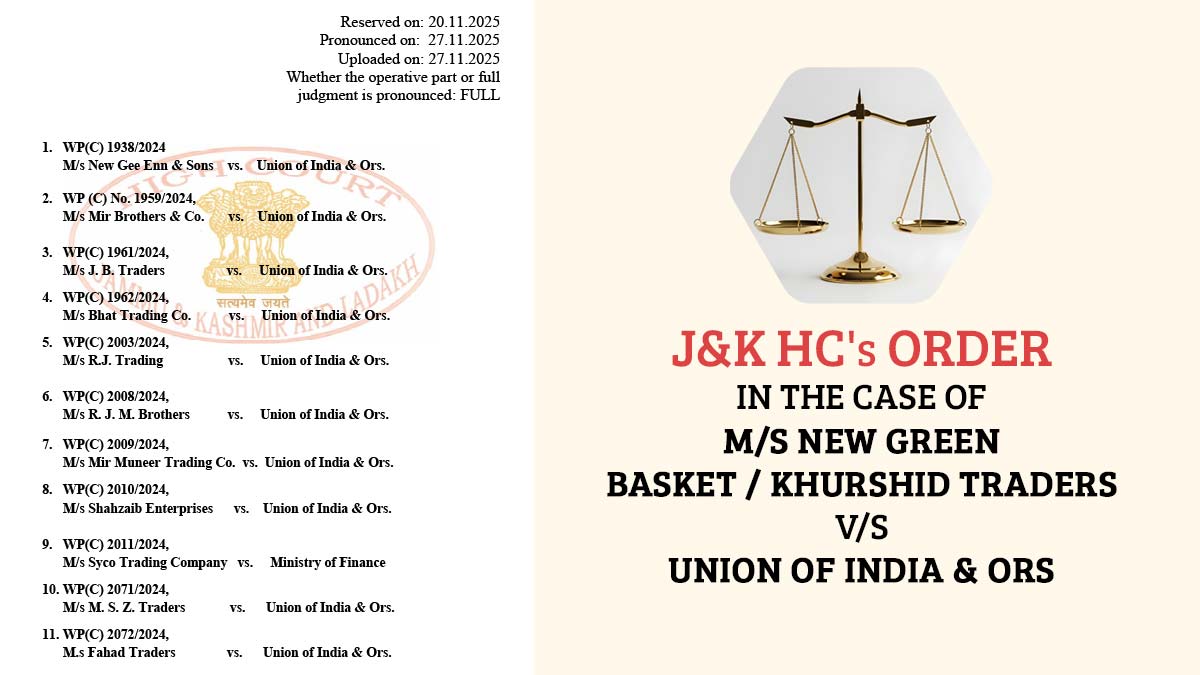
The Jammu and Kashmir High Court has delivered an important ruling clarifying the GST treatment of trade conducted across the Line of Control (LoC) between Jammu and Kashmir and Pakistan-occupied Kashmir (PoK). The court held that such trade qualifies as intra-state trade and therefore does not attract Goods and Services Tax. This judgment reinforces the long-standing constitutional position that PoK is an integral part of Jammu and Kashmir and, by extension, India.
Background of the LoC Trade Issue
Trade across the Line of Control began as a confidence-building measure between India and Pakistan and remained operational for several years before being suspended in 2019 due to security concerns. Despite political and administrative changes, including the revocation of Article 370, the constitutional stance regarding PoK has not changed. Even after the reorganisation of the state into a Union Territory, 24 seats in the J&K Legislative Assembly continue to remain reserved for PoK, underlining India’s official position on the region.
High Court’s Observations on GST Applicability
The division bench of Justice Sanjeev Kumar and Justice Sanjay Parihar examined petitions filed by traders who were issued show cause notices under the Central Goods and Services Tax Act, 2017. The court observed that since PoK is considered part of the erstwhile State of Jammu and Kashmir, both the location of the supplier and the place of supply fall within the same state or Union Territory. As a result, the trade carried out across the LoC during the relevant period was intra-state in nature.
The bench clearly stated that such trade could not be treated as inter-state or international supply and therefore was not liable to GST. This observation brought clarity to a long-pending dispute that arose after the introduction of GST in 2017.
Traders’ Stand and Legal Arguments
The traders argued that when cross-LoC trade was initiated in 2008, it was governed by the Jammu and Kashmir Value Added Tax Act, under which such trade was exempt from tax. They further submitted that the Standard Operating Procedure issued by the Government of India on October 20, 2008, treated cross-LoC trade as intra-state trade. According to them, the same principle should continue even under the GST regime.
Another key argument raised was that the cross-LoC trade operated purely on a barter system. Since there was no monetary consideration involved in the exchange of goods, the traders contended that even if GST provisions were examined, the absence of consideration would make tax demands invalid.
Government Action and Suspension of Trade
The Indian government suspended cross-LoC trade on April 9, 2019, after investigations revealed misuse of trade routes. Security agencies found that the routes were allegedly being used for smuggling illegal weapons, narcotics, and counterfeit currency. A probe by the National Investigation Agency also highlighted the involvement of individuals linked to banned terrorist organisations, which led to the complete suspension of both cross-LoC trade and bus services.
History of Cross-LoC Trade and Connectivity
The initiative to improve people-to-people contact across the LoC started with the launch of the Karwaan-e-Aman, or Peace Caravan, bus service between Srinagar and Muzaffarabad on April 7, 2005. This was followed by the commencement of barter-based trade on October 21, 2008, through two routes: Salamabad (Uri)–Muzaffarabad and Poonch–Rawalakot. Traders on both sides were permitted to exchange 21 mutually agreed items under strict conditions.
Case Details
| Particulars | Details |
|---|---|
| Case Title | M/s New Green Basket / Khurshid Traders vs. Union of India & Ors |
| Case Number | WP(C) 2480/2025 |
| For Petitioners | Mr Tahir Majid Shamsi, Ms Rehana Qayoom, Mr Waseem Gul, Mr Mohd Younus Hafiz, AC & Ms Nowhabar Khan |
| For Respondents | Mr S. F. Qadiri, Mr Numan Zargar, Ms Snober Sameer, Mr Sikander Hayat Khan |
| Court | Jammu and Kashmir High Court |
Significance of the Ruling
This judgment is significant for GST law interpretation, especially in matters involving unique constitutional and territorial considerations. By holding that cross-LoC trade with PoK is intra-state, the High Court has provided relief to affected traders and reaffirmed the constitutional position of the region. For GST practitioners and businesses following legal developments, this ruling serves as a key precedent in understanding how GST applies in special geopolitical contexts.