
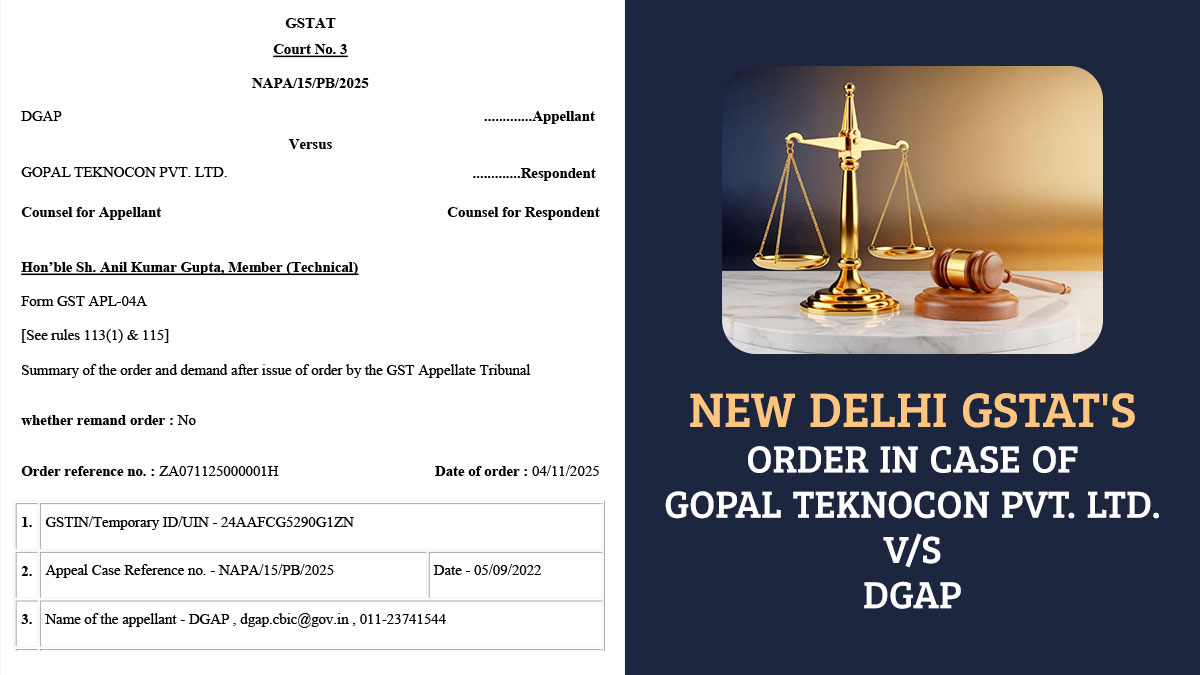
The Goods and Services Tax Appellate Tribunal (GSTAT), Principal Bench at New Delhi, has delivered an important ruling clarifying the scope of anti-profiteering proceedings under the GST law. The Tribunal held that once a contractor voluntarily deposits or passes on the determined input tax credit (ITC) benefit to the recipient, no further action is required under Section 171 of the Central Goods and Services Tax Act, 2017. This judgment provides much-needed certainty for contractors and service providers facing anti-profiteering investigations.
Background of the Case and Issues Involved
The matter arose from an appeal filed by the Directorate General of Anti-Profiteering (DGAP) before the GSTAT, Principal Bench. The Bench, comprising Justice Sh. Anil Kumar Gupta, Technical Member, examined whether the respondent contractor had failed to pass on the benefit of incremental ITC or tax rate reduction to the recipient, as mandated under Section 171(1) of the CGST Act. Another key issue before the Tribunal was whether the computation of the alleged profiteered amount made by the DGAP was acceptable and enforceable.
Indian Oil Corporation Ltd., Pipeline Division, Rajkot, had initially filed a complaint alleging that its contractor, Gopal Teknocon Pvt. Ltd., did not pass on the benefit of additional ITC that became available after the introduction of GST. The contractor was engaged in maintenance and inspection work of crude oil storage tanks, and the complaint alleged violation of anti-profiteering provisions under GST law.
DGAP Investigation and Findings
Following the complaint, the Standing Committee on Anti-Profiteering referred the matter to the DGAP for investigation. After detailed examination, the DGAP concluded that the respondent contractor was not able to pass on the incremental ITC benefit arising post-GST implementation. Accordingly, the DGAP computed the amount representing the ITC benefit that should have been passed on to the recipient.
Importantly, during the proceedings before GSTAT, the respondent acknowledged the DGAP’s computation in its written submissions. The contractor also complied with its obligation by depositing the quantified amount, thereby passing on the ITC benefit as determined by the investigating authority.
GSTAT’s Observations and Final Ruling
The GSTAT carefully examined the facts, submissions, and compliance status of the respondent. The Bench noted that the respondent had fulfilled its statutory obligation under Section 171(1) of the CGST Act by passing on the quantified ITC benefit. The Tribunal affirmed the DGAP’s computation and observed that once compliance is achieved, continuation of anti-profiteering proceedings is unwarranted.
The Bench categorically held that no further action is required under the anti-profiteering provisions once the benefit has been properly passed on and verified. The investigation was therefore concluded, and the appeal did not result in any additional liability or penalty for the respondent contractor.
Anti-Profiteering Provisions Are Remedial, Not Punitive
While delivering the ruling, the GSTAT also highlighted the underlying objective of anti-profiteering provisions under GST. The Tribunal emphasized that these provisions are remedial in nature and primarily aimed at protecting consumer welfare. They are not intended to function as punitive measures once compliance has been ensured. According to the Bench, continuing proceedings after the benefit has been passed on serves no regulatory or public interest purpose.
This observation is significant as it reinforces the principle that the goal of anti-profiteering law is to ensure fair transmission of tax benefits, not to penalize businesses that rectify non-compliance by voluntarily meeting their obligations.
Case Details at a Glance
| Particulars | Details |
|---|---|
| Case Title | Gopal Teknocon Pvt. Ltd. vs. DGAP |
| Case Number | NAPA/15/PB/2025 |
| Forum | GSTAT, Principal Bench, New Delhi |
| Key Issue | Passing on of ITC benefit under Section 171 CGST Act |
| Outcome | No further action after compliance |
Why This Ruling Matters for GST Taxpayers
This GSTAT New Delhi ruling sets an important precedent for contractors, service providers, and businesses operating under GST. It clarifies that voluntary compliance and passing on of ITC benefits, once quantified by DGAP, effectively closes the matter under anti-profiteering law. For taxpayers, this decision brings reassurance that corrective action and cooperation during investigations can prevent prolonged litigation and additional proceedings.
Overall, the judgment strengthens the interpretation that GST anti-profiteering provisions are meant to ensure fairness and transparency in tax benefit transmission, aligning enforcement with the broader objective of consumer welfare under the GST regime.