
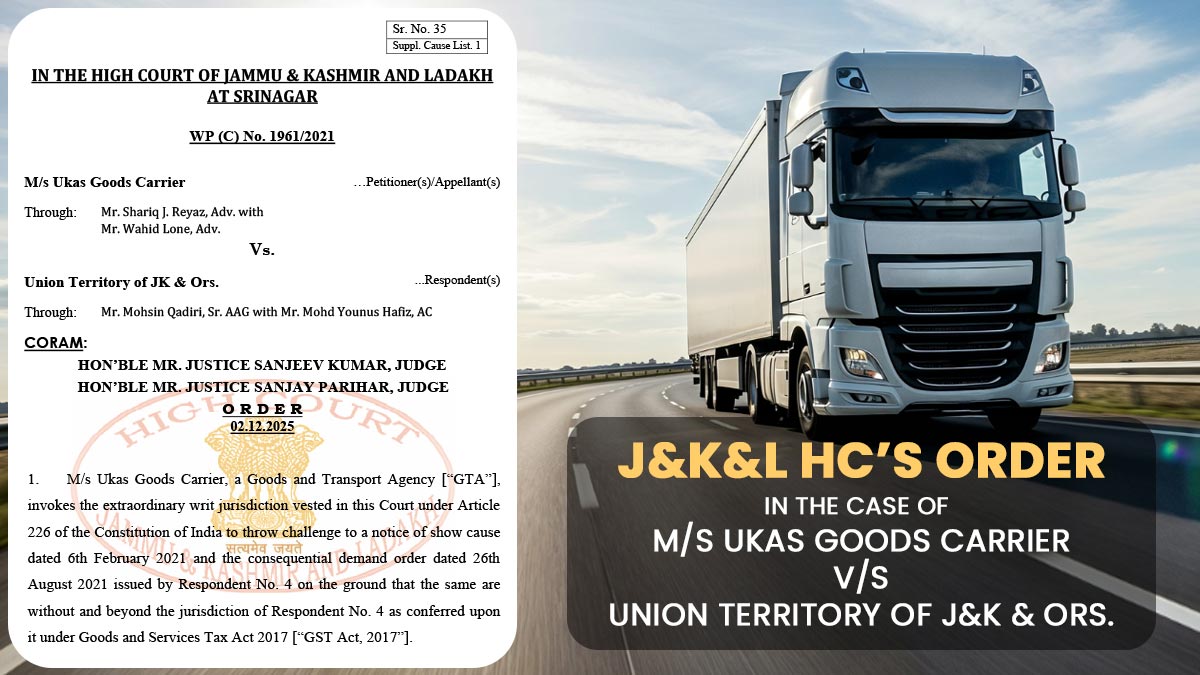
In an important GST-related judgment, the High Court of Jammu & Kashmir and Ladakh has clearly held that tax authorities cannot raise a final GST demand exceeding the amount proposed in the Show Cause Notice (SCN). The Court emphasized that such action violates both the provisions of GST law and the principles of natural justice. This ruling brings clarity and relief to taxpayers facing excessive tax demands without prior notice.
Background of the Case
The matter was heard by a Division Bench comprising Justice Sanjeev Kumar and Justice Sanjay Parihar. The case involved a Goods Transport Agency (GTA) against whom GST authorities had issued a Show Cause Notice proposing a certain tax liability. However, when the final order was passed, the demand amount was substantially higher than what was mentioned in the SCN. Observing this discrepancy, the High Court intervened and examined the legality of such a demand.
Key Argument by the Goods Transport Agency
The petitioner, a Goods Transport Agency, challenged both the SCN and the final GST demand order through a writ petition. The main argument was that, under the reverse charge mechanism, the liability to pay GST on transportation services rests with the service recipient and not with the transporter. In addition, the petitioner pointed out that the SCN proposed a tax demand of approximately Rs 4.59 crore, whereas the final order confirmed a demand of nearly Rs 7.62 crore, which was not permissible under GST law.
Stand of the GST Department
The GST Department opposed the petition and argued that the taxpayer had an alternative remedy available in the form of an appeal. The department also stated that the taxpayer was involved not only in transport services but also in the supply of goods. However, during the proceedings, the department failed to provide a satisfactory explanation as to how the final demand could legally exceed the amount specified in the Show Cause Notice.
Court’s Observations on GST Law and Natural Justice
The High Court, while hearing the matter at Srinagar, noted that GST law clearly requires a Show Cause Notice to specify the precise amount of tax, interest, and penalty proposed to be recovered. This requirement ensures that the taxpayer gets a fair and reasonable opportunity to respond. The Court categorically stated that authorities are barred from confirming a demand higher than what is proposed in the SCN. Such action undermines transparency and fairness in tax administration.
Scope for Issuing a Fresh Show Cause Notice
The Bench further clarified that if the assessing authority believes that a higher amount is actually payable, it is not without remedy. The authority may issue a fresh Show Cause Notice for the additional amount, provided it is issued within the prescribed limitation period under GST law. However, enhancing the demand directly in the final order without issuing a new notice is not legally sustainable.
Final Decision of the High Court
Considering that the demand order violated statutory provisions as well as the principles of natural justice, the High Court quashed both the original Show Cause Notice and the final GST demand order. The Court directed the assessing authority to reconsider the matter and pass a fresh order strictly in accordance with law after following due process.
Case Details
| Particulars | Details |
|---|---|
| Case Title | M/s Ukas Goods Carrier vs Union Territory of JK & Ors. |
| Case No. | WP (C) No. 1961/2021 |
| Counsel for Petitioner | Mr. Shariq J. Reyaz, Advocate with Mr. Wahid Lone, Advocate |
| Counsel for Respondent | Mr. Mohsin Qadiri, Senior AAG with Mr. Mohd Younus Hafiz, AC |
| Court | High Court of Jammu & Kashmir and Ladakh |
Significance of the Judgment
This ruling serves as a strong reminder that GST authorities must strictly adhere to the amounts proposed in Show Cause Notices and cannot surprise taxpayers with enhanced demands at the final stage. For businesses and professionals tracking GST news updates, this judgment reinforces the importance of procedural fairness and strengthens taxpayer safeguards under the GST framework.