
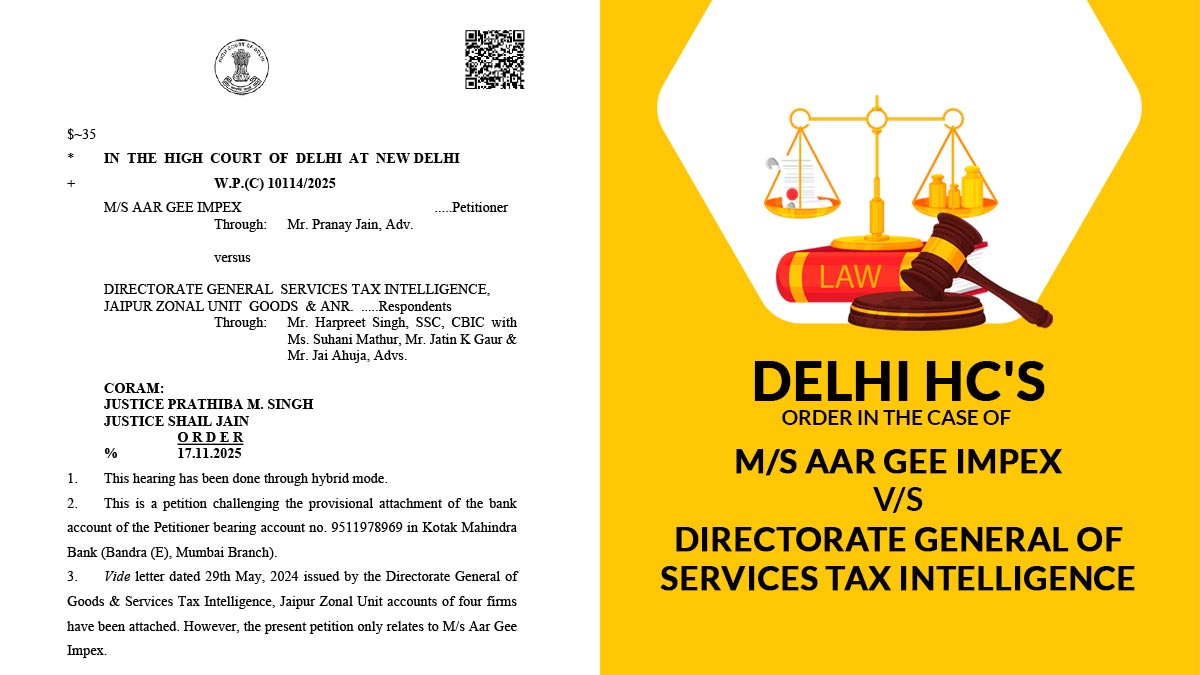
In a significant relief for taxpayers, the Delhi High Court has held that a provisional attachment order passed under Section 83 of the Central Goods and Services Tax Act, 2017 cannot continue beyond the statutory period of one year. The Court directed the release of a provisionally attached bank account while imposing a condition to maintain a minimum balance, reinforcing the principle that such extraordinary powers cannot be exercised indefinitely without due process.
Background of the Case
The writ petition was filed by M/s Aar Gee Impex challenging the provisional attachment of its current bank account maintained with Kotak Mahindra Bank, Bandra (East), Mumbai. The attachment was ordered by the Directorate General of Goods and Services Tax Intelligence, Jaipur Zonal Unit, as part of a group action involving four entities. However, the present proceedings were confined specifically to M/s Aar Gee Impex and its grievance regarding the continued freezing of its bank account.
Petitioner’s Arguments Before the Court
Appearing on behalf of the petitioner, Mr Pranay Jain argued that Section 83 of the GST Act clearly prescribes a maximum validity of one year for a provisional attachment order. He submitted that despite allegations of GST evasion, the department had neither issued a Show Cause Notice nor initiated adjudication proceedings. According to the petitioner, continuation of the bank account freeze beyond one year without further statutory action was legally untenable and caused serious hardship to the business.
Stand of the GST Department
The respondent authorities, represented by Mr Harpreet Singh, Ms Suhani Mathur, Mr Jatin K. Gaur, and Mr Jai Ahuja, contended that M/s Aar Gee Impex was allegedly involved in GST evasion amounting to approximately Rs 11.37 lakh. The department claimed that the evasion occurred through bogus and ineligible input tax credit availed from non-existent entities, justifying the provisional attachment of the bank account to safeguard revenue interests.
Observations and Ruling of the Delhi High Court
The Division Bench comprising Justice Prathiba M. Singh and Justice Shail Jain examined the scope and limitation of Section 83 of the GST Act, 2017. The Court categorically observed that a provisional attachment order automatically ceases to operate after the completion of one year from the date of issuance and cannot be extended by implication or administrative action.
In the present case, the attachment order was dated 29 May 2024. As no Show Cause Notice had been issued even after the expiry of one year, the Court held that the attachment had lapsed by operation of law. The judges emphasized that provisional attachment is a drastic measure and must strictly adhere to the statutory framework.
Relief Granted and Conditions Imposed
While allowing the petitioner to operate its bank account freely, the Court took note of the department’s allegations of GST evasion. Balancing the interests of revenue and the taxpayer, the Court directed that M/s Aar Gee Impex shall maintain a minimum balance of Rs 10,00,000 in the said bank account. With these directions, the provisional attachment order dated 29 May 2024 was formally lifted, and the writ petition was disposed of.
Case Details
| Particulars | Details |
|---|---|
| Case Title | M/s Aar Gee Impex vs. Directorate General of Services Tax Intelligence |
| Case No. | W.P.(C) 10114/2025 |
| For Petitioner | Mr Pranay Jain |
| For Respondent | Mr Harpreet Singh, Ms Suhani Mathur, Mr Jatin K. Gaur, Mr Jai Ahuja |
| Court | Delhi High Court |
Why This Judgment Matters for GST Taxpayers
This ruling reaffirms that provisional attachment under GST law is time-bound and cannot be used as a tool for prolonged coercive recovery without following due legal procedure. For businesses facing bank account freezes under Section 83, the judgment provides clarity and relief by ensuring that statutory safeguards are respected and that enforcement actions remain proportionate and lawful.