
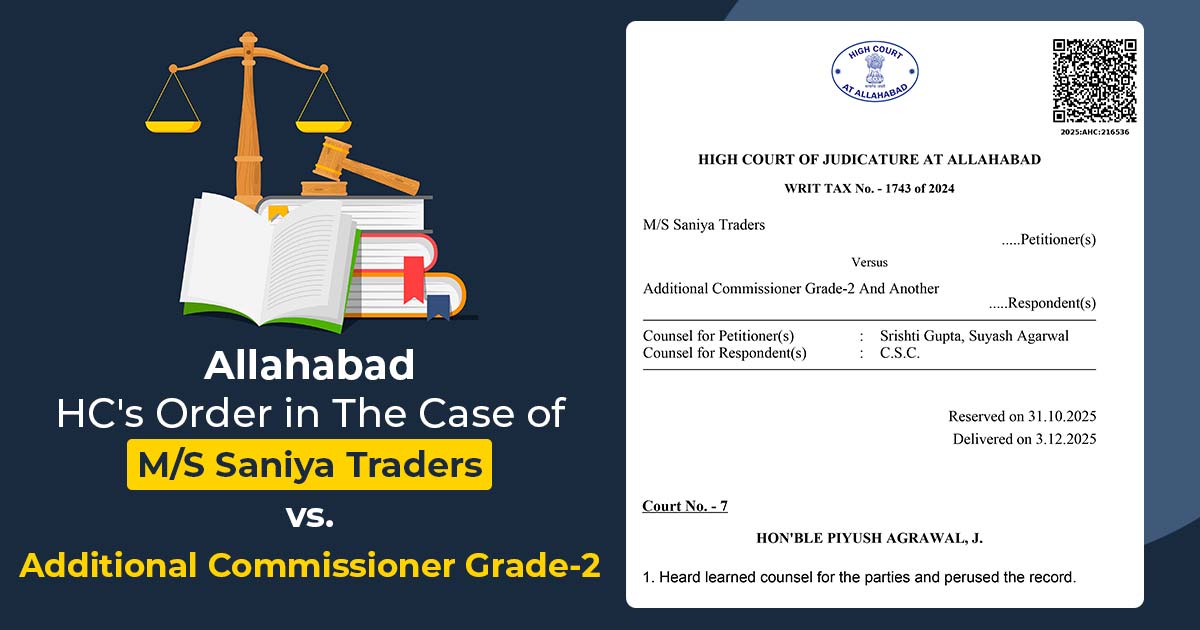
The Allahabad High Court has delivered an important ruling clarifying that Input Tax Credit cannot be denied to a genuine recipient merely because the supplier’s registration was cancelled at a later stage, as long as the supplier was duly registered under GST on the date of the transaction and had complied with return filing and tax payment requirements. This judgment provides significant relief to bona fide taxpayers facing ITC reversals due to subsequent actions taken against suppliers.
The Bench led by Justice Piyush Agrawal set aside a GST demand of ₹9.42 lakh raised under Section 74 of the CGST and UPGST Acts, holding that denial of ITC in such circumstances is unsustainable. The Court emphasized that the recipient cannot be penalized for events beyond its control when the transaction itself was backed by valid documentation and statutory compliance at the relevant time.
Background of the Case and Transaction Details
The case involved M/s Saniya Traders, a registered GST dealer engaged in the business of waste plastic, polymer scrap, and related materials. The petitioner had entered into a purchase transaction on 28 June 2021 with Mohan Enterprises, Muzaffarpur, Bihar, for the purchase of old scrap batteries. The transaction was supported by a valid tax invoice bearing number ME 28/2021-22 and a corresponding e-way bill issued on the same date, clearly indicating movement of goods.
Mohan Enterprises, the supplier, was a registered GST taxpayer at the time of the transaction. The sale was duly reported in the supplier’s GSTR-1, and the corresponding tax liability was discharged through GSTR-3B. The petitioner also demonstrated that the consideration amount, including the IGST component, was paid through normal banking channels, leaving no scope for doubt regarding the genuineness of the transaction.
Investigation and GST Department’s Stand
The controversy arose following an investigation conducted by the Joint Commissioner, State Tax, Central Investigation Bureau, Patna, which examined a network of 42 alleged non-existent suppliers operating across Uttar Pradesh and Bihar. According to the investigation report, these entities were allegedly involved in issuing invoices without actual supply of goods, leading to fraudulent availment and transfer of ITC.
Based on this report, the UP GST authorities concluded that Mohan Enterprises was part of the suspicious network. As a result, the purchase transaction entered into by Saniya Traders was treated as non-genuine, and the ITC availed on the said transaction was proposed to be reversed.
Show Cause Notice and Adjudication Under Section 74
A Show Cause Notice dated 27 September 2021 was issued to the petitioner, alleging wrongful availment of ITC. In response, Saniya Traders submitted a detailed reply along with documentary evidence, highlighting that the supplier was registered at the time of supply, had filed statutory returns up to July 2021, and had paid the applicable taxes.
Despite the explanation and supporting records, the Assistant Commissioner proceeded to pass an order under Section 74 on 20 December 2022, reversing the ITC amounting to ₹9,41,799 along with interest and an equivalent penalty. The appellate authority subsequently dismissed the appeal on 5 February 2024, which led the petitioner to approach the Allahabad High Court through a writ petition.
High Court’s Observations and Legal Reasoning
The Allahabad High Court carefully examined the facts and noted that Mohan Enterprises was a validly registered GST dealer on 28 June 2021, the date of the transaction. The Court observed that the registration of the supplier was cancelled only at a later point in time and that such subsequent cancellation cannot retrospectively invalidate a transaction that was otherwise compliant with GST law.
The Court categorically held that if the selling dealer was registered at the time of supply and had filed GSTR-1 and GSTR-3B reflecting the transaction and tax payment, the recipient’s ITC cannot be denied merely on the basis of later developments. The judgment reiterated that Section 74, which deals with cases involving fraud, wilful misstatement, or suppression of facts, cannot be invoked mechanically without establishing active involvement or knowledge of wrongdoing on the part of the recipient.
Key Takeaway for GST Taxpayers
This ruling reinforces the principle that bona fide recipients should not suffer ITC reversals solely due to subsequent adverse findings against suppliers, provided they have exercised due diligence and complied with statutory requirements. The decision is expected to act as a strong precedent in cases where ITC is questioned despite genuine transactions supported by valid invoices, e-way bills, and return filings.
Case Details
| Particulars | Details |
|---|---|
| Case Title | M/s Saniya Traders vs. Additional Commissioner Grade-2 |
| Case Number | WRIT TAX No. 1743 of 2024 |
| Counsel for Petitioner | Srishti Gupta, Suyash Agarwal |
| Counsel for Respondent | C.S.C. |
| Court | Allahabad High Court |
This judgment once again highlights the importance of transactional compliance and provides much-needed clarity on the scope of ITC denial under Section 74, strengthening taxpayer confidence in the GST framework.